
The Relevance Check
How I Tune Out the Noise and Chaos to Focus on What Matters

We’re living in a time when information is endless, certainty is scarce, and every day seems to come with a new theory, threat, or “truth” demanding our attention. Somewhere along the way, staying informed quietly turned into staying overwhelmed.
When I look at the energy online, it feels like everyone thinks the answer is to figure everything out, such as finding the right narrative, the real explanation, the hidden cause beneath the chaos. There is a lot of focus on getting the “truth” out, but I notice it only ends up as a source of frustration when two sides each have an opposing truth and different facts, studies, or figures to back it up.
Sometimes even pushing for the truth to come out doesn’t end of doing anything. Corruption or injustices appear to go unaddressed or ignored despite people yelling as loud as they can about them (metaphorically). The “bad guy” always seems to be getting away with something. Which, I know for me, can end up leaving me feeling defeated or helpless.
I often find it simpler and more stabilizing to understand that not everything needs my attention, and not everything I can know actually helps me solve a problem or deception I feel faced with, especially those that exist at a collective level.
What these confusing times has taught me is that there is a difference between being curious and being consumed. Between caring and carrying too much. Between being distracted and focused on what is relevant.
The Exhaustion of Trying to Know Everything
So much of our collective anxiety right now comes from being exposed to more information than we were ever meant to process. We’re asked to have opinions on global conflicts, economic systems, wars or other threats, scientific claims, political strategies, cultural debates, who we should love or hate, etc., sometimes even before all the facts have come out about a situation or event. And much of it is presented urgently, emotionally, and without context. The result, for me isn’t clarity. It’s overwhelm and paralysis.
I notice that when people feel overwhelmed, they often respond in one of two ways:
they either disengage entirely, or they try to chase certainty, such as through watching more videos, reading more threads, digging deeper in hopes that this next piece of information will finally make everything make sense.
But chasing truth can quietly become a trap.
When Truth-Seeking or Truth Exposing Stops Being Helpful
This may sound uncomfortable, but it’s something I’ve had to accept for my own sanity: not every truth is actionable or exposable in ways that will lead to someone or something outside of ourselves taking action (or the action we want).
Some information might be technically true and knowing or exposing it might still do nothing but agitate our own or others’ nervous systems. Some questions don’t have answers that change how we live, love, or act. They only influence how anxious or helpless we feel. And some “truths” are presented in ways that invite outrage or fear without offering any meaningful way forward.
Some people might not know what to pay attention to or what not to, or might even feel guilty if they feel they aren’t “caring” enough. But it is important to remember that being informed isn’t the same thing as being effective.
At a certain point, consuming more information doesn’t lead to insight. It leads to rumination. And rumination looks a lot like engagement, but it doesn’t actually move anything.
The Filter I Use to Weed Out What To Focus On: Relevance and Agency
Over time, I’ve learned to run information through a different filter, one that isn’t about whether something is interesting, shocking, or even possibly true.
I ask myself:
Does this affect something I can realistically influence?
Does this change how I live, choose, create, or care?
Does this lead to action, clarity, or compassion as opposed to just reaction?
If the answer is no, I let it go.
This isn’t about apathy. It’s about stewardship of attention. I only have so much mental and emotional energy, and I’ve learned to give it to the places where it can actually do some good.
Action as an Anchor
One of the most grounding things I’ve learned is that action steadies the mind. Even small, imperfect action.
That might look like:
focusing on relationships you can tend
creating something tangible
improving one corner of your life or community
learning something because it helps you do something, not just argue about it
I also try to empower myself as opposed to giving power away (which I am in no way trying to claim I am perfect at) by:
approaching situations, asking how I can contribute in positive ways (or where I have contributed in negative ways), rather than getting stuck on what others can do, or did or didn’t do.
looking for ways to support myself or others through a challenge, instead of waiting for someone else to step in and rescue a situation.
paying attention to the types of actions that aren’t working (or creating a feeling of release or resolution) in order to come up with a different approach.
Action doesn’t require total certainty. It requires direction,
When I feel pulled into endless commentary or hypothetical futures, I try to return to questions like: What can I build? What can I contribute? What is within reach right now? What can I teach instead of just expose? How can I think out of the box so that I can dream up an out-of-the box solution or something I can take action with?
Those questions don’t make me feel either ignorant or superior to others, they simply make me feel oriented.
Tuning Out Without Checking Out
Tuning out the noise doesn’t mean pretending the world is fine or turning away from suffering. It means recognizing that constant exposure to everything does not equal responsibility.
There’s a difference between being awake and being overwhelmed.
We don’t need to carry every crisis in our body to care about the world. We don’t need to decode every narrative to live ethically. And we don’t need to have an opinion on everything in order to act with integrity where we are.
Here is where discernment can become a quiet form of resistance.
Choosing Relevance in a Loud World
We live in a culture that rewards reaction more than reflection, certainty more than humility, and volume more than wisdom. In that environment, choosing relevance over noise can feel almost radical, but also deeply human.
I don’t believe the answer to confusion is figuring everything out. I think it’s learning how to decide what actually matters, giving attention, care, and effort to those things.
Clarity doesn’t always come from knowing more.
Sometimes it comes from knowing what to ignore.
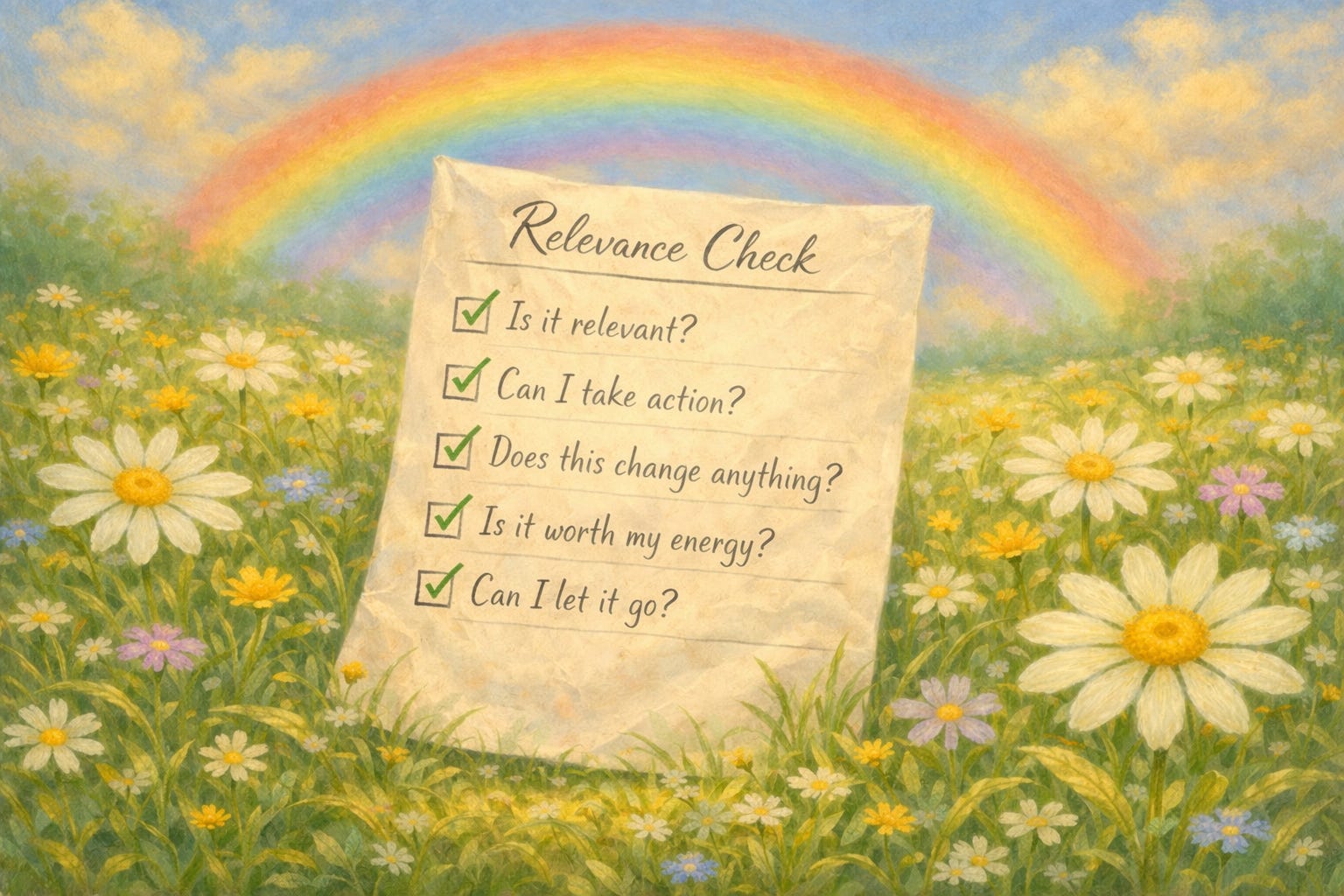
A Simple Relevance Check
When something pulls at your attention, such as a headline, a video, a theory, or a debate, pause and ask:
1. Is this relevant to my life right now? (Not interesting or alarming, but relevant).
2. Does this affect something I can influence or respond to? (Even in a small, local, or imperfect way).
3. Does knowing this change how I live, choose, create, or care? (If it doesn’t alter behavior, values, or action, it may not need to occupy space in my head).
4. Does this invite action, clarity, or compassion as opposed to just reaction (Reaction can be draining, while action can be grounding).
5. If I let this go, what would I actually lose? (If the answer is nothing essential, then I don’t need to obsess about it).
If something doesn’t pass the relevance check, it’s okay to release it. Not because it doesn’t matter, but keeping sane in an insane world matters more.